The permanent home of the book

Reclaiming Your Hours with AI.

This address always has the newest edition. Bookmark it. When the book gets updated, what you download here updates with it, at no cost, for as long as the book exists.

Get the book →

Free. A first name, an email, and about a minute.

A look inside

Read a few pages before you decide.

Four chapters, exactly as they appear in the manuscript. No email needed to read this.

Chapter 2

The one number that decides everything

Dave can price a job from the truck to within fifty dollars. He knows the cost of copper moved before his supplier does. Ask him what one hour of Dave is worth and you get "depends on the week."

It can't depend on the week. Every decision in this book leans on that number, so pin it down now. Two divisions, done tonight, on the back of whatever's in the truck.

Start with what the business pays you in a year. Salary, draws, the profit that's really wages in a costume: the honest total, not the tax return's version and not the dream. If the number's lumpy, use what a sane year looks like.

Divide it by 2,000. That's fifty weeks times a forty-hour week, and yes, you and I both know nobody who owns a business works forty. Use it anyway. It's a ruler, not a diary, and 2,000 keeps the math kind: knock off three zeros, divide by two.

Say the yearly number is $120,000. Then an hour of you earns about $60. At $200,000, about $100. Yours is yours. Write it down, in pen.

Now the strange step, and the whole trick. Take that hourly number and divide it by four.

The rest of the chapter is in the book.
Chapter 6

Thirty minutes to a working assistant

The build: about thirty minutes, once. Hours back today: none, and that's honest. This is the chapter that makes every number after it possible.

If you came straight here from the front of the book, good. This is the right place to start building, and nothing in the five chapters you skipped is required tonight.

Right now you are the only person who knows how your business works. Not in a dramatic way. In a boring, Tuesday-afternoon way. Your pricing lives in your head and in a spreadsheet you'd have to explain. The reason you don't take jobs past Kanata is a thing you know, not a thing that's written anywhere. The way you talk to a customer who is upset versus a customer who is just checking in: that's twenty years of instinct, and it has never once been typed out.

This chapter fixes that once, and it's the only chapter in the book with no task to kill. It's the one that makes the other twenty killable. Thirty minutes answering questions about your own business, and at the end you'll have an assistant that already knows your pricing, your service area, your voice, and the four things you refuse to do. Do it properly and chapter 7 takes ten minutes, and chapter 7 usually pays the biggest single number in the book. Skip it and chapter 7 doesn't work.

Why it has to happen at all: every time you want help, you have to explain the business first. That's the tax. It's why hiring is slow, why handing anything off feels harder than just doing it, and why most people who try AI quit in the first week. They open a blank chat box, type "help me write a quote", get back something generic that could belong to any company in the country, and conclude the thing doesn't work.

The rest of the chapter is in the book.
Chapter 7

The inbox that empties itself

The build: about ten minutes, inside your chapter 6 Project. Hours back: readers who time it honestly typically find four to six a week, the biggest single number in the book. Yours is the one you'll measure.

Dave checks his email nine times a day, and eight of those times there's nothing in it for him.

He's an electrician in Moncton. Between the second job and the third one he's sitting in the truck with his phone, thumbing through forty new messages to find the one from the general contractor who actually needs an answer before noon. Supplier promotions. A newsletter he never signed up for. Two customers asking the same question his website already answers. And buried in the middle, one real quote request that's been sitting there since 7:40 this morning.

That's the job. Not writing email. Finding it. Reading everything to locate the four messages that matter, and then typing out the same six replies you've typed a thousand times: yes we service your area, here's roughly what that costs, I can come Thursday, send me a photo of the panel, we don't do that kind of work, thanks for the kind words.

You already know what you'd say. You've said it a thousand times. The tax is saying it again, one thumb, in a parking lot.

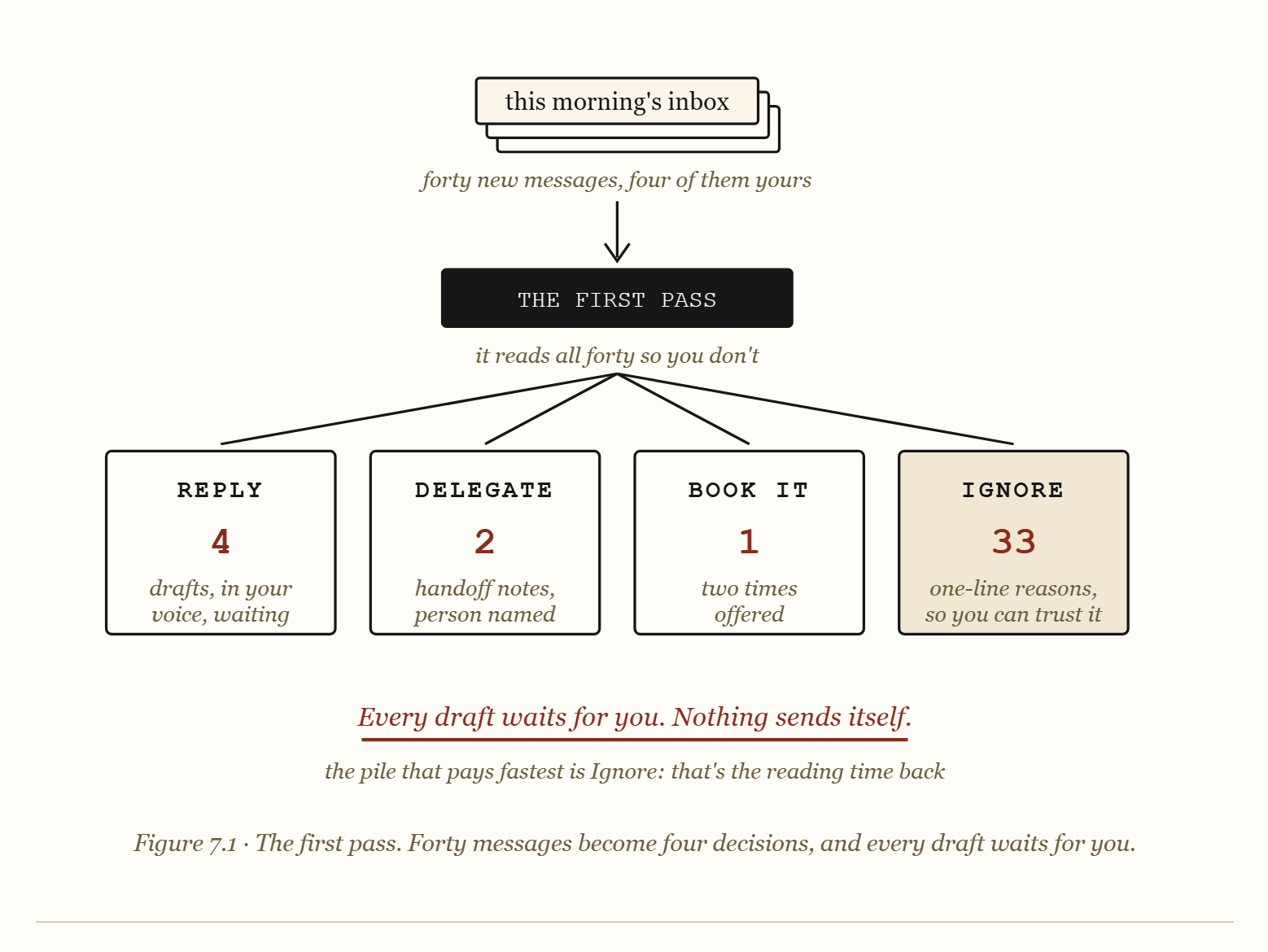
This chapter kills that job. Not by answering your email for you. By sorting it into four piles and handing you drafts, in your voice, that you approve before anything moves. You stay the sender. You stop being the typist.

The rest of the chapter is in the book.
Chapter 11

Quotes and proposals that write themselves

The build: about ten minutes, feeding it quotes you already sent. Hours back: readers who quote weekly typically find two to four a week, plus the quotes that now go out at all.

Remember Dave's inbox in chapter 7? There was a quote request buried in it, sitting since 7:40 that morning. This chapter is about what happens after he finally finds it.

Because finding it was the easy part. Now he has to write the thing. And Dave, who can price a job from the truck to within fifty dollars, who knows the cost of copper moved before his supplier does, is going to sit at the kitchen table at nine at night rebuilding a document he has built two hundred times. Opening the last similar quote to copy from. Retyping the line items. Trying to remember what he charged the condo board on Mountain Road for almost exactly this. Fixing the date, fixing the name, hoping he caught everywhere the old customer's name was hiding.

Say the quiet part: the pricing takes him four minutes. The document takes him forty. You are not slow at quoting. You are slow at typing, formatting, and remembering, and none of those three is the part you're good at or the part the customer is paying for.

There's a second cost hiding in the pile. Somewhere in your phone is a job you priced in your head, told the customer "I'll send you something this week", and never did. Not because you didn't want the work. Because the document stood between you and sending it, and the document lost to supper, twice, and then it was awkward.

This chapter moves the document to the machine. You describe the job in three lines. It comes back as a full quote, in your numbers, in your words, with your terms attached. You check it, fix what's wrong, and send it. The pricing stays yours. The typing stops being.

The rest of the chapter is in the book.
Get the whole book Free · 26 chapters · PDF and in your browser

The download

Two files. Take both, or take one.

The book is the thing you read. The workbook is the thing you fill in. They are built from the same material, and chapter 3 of the book is the audit the workbook walks you through, so most people end up wanting both.

The book · read it

Reclaiming Your Hours with AI

The full book. Start at chapter 1 and work down the ladder, or jump to the chapter that names the job currently eating your week.

The browser version does the arithmetic for you and remembers what you type in, on your own device. The PDF is the one to print.

The workbook · fill it in

The companion workbook

Sixteen short modules with the exercises laid out to be finished, not admired. It adds up your hours as you go.

Works in any browser, on a phone as well as a laptop. Nothing to install.

Where should the files go?

First name and email, and everything above arrives in about a minute.

The tick is optional and the files come either way.

What is in it

Twenty-six chapters. Five rungs. One climb.

Every chapter names one job you are doing by hand, walks you through handing it off, then asks you to time what came back. The chapters stack into five rungs, climbed in order, and the order is the method: admin first, because those wins are the fastest, and every rung you finish funds the nerve for the next one.

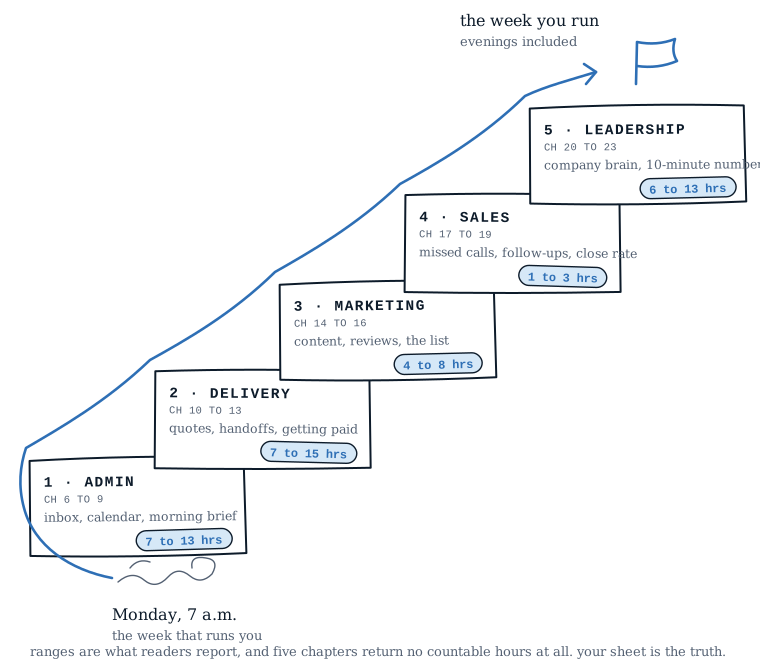
The whole book as a climb of five rungs, from the week that runs you at the bottom to the week you run at the top. Admin, chapters 6 to 9, 7 to 13 hours a week back. Delivery, chapters 10 to 13, 7 to 15 hours. Marketing, chapters 14 to 16, 4 to 8 hours. Sales, chapters 17 to 19, 1 to 3 hours plus leads answered and close rate. Leadership, chapters 20 to 23, 6 to 13 hours. A footnote says the ranges are what readers report, five chapters return no countable hours at all, and your sheet is the truth.

The admin rung, up close

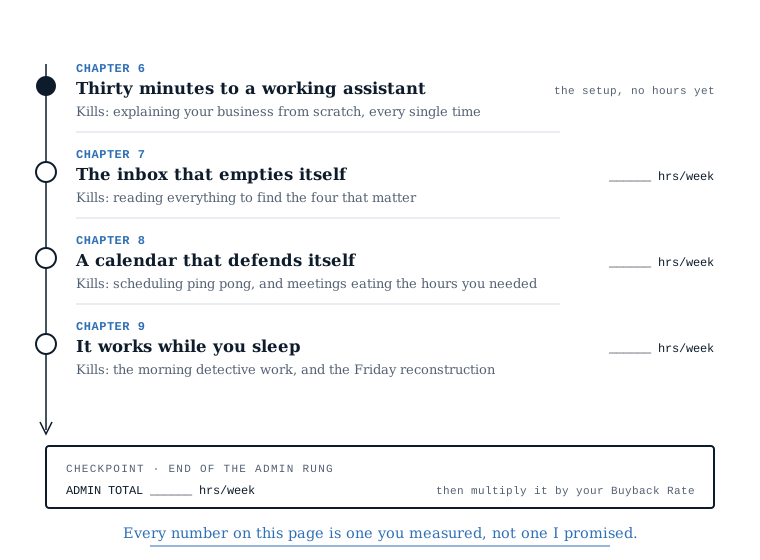
The first rung in detail, because it is the one you will climb this week. Chapter 6 is the thirty-minute install; the three after it each kill one job and leave a blank for what you measured.

The four chapters as rungs on a ladder. Chapter 6 builds an assistant that knows your business and is the setup, with no hours yet. Chapter 7 kills reading everything to find the four messages that matter. Chapter 8 kills scheduling ping pong and meetings eating the hours you needed. Chapter 9 kills the morning detective work and the Friday reconstruction. Chapters 7, 8 and 9 each leave a blank for hours per week, and they add up in a checkpoint box at the end of the admin rung, which you then multiply by your Buyback Rate.

A look inside

Real pages, not mockups. This is what the four chapters actually look like when you open them.

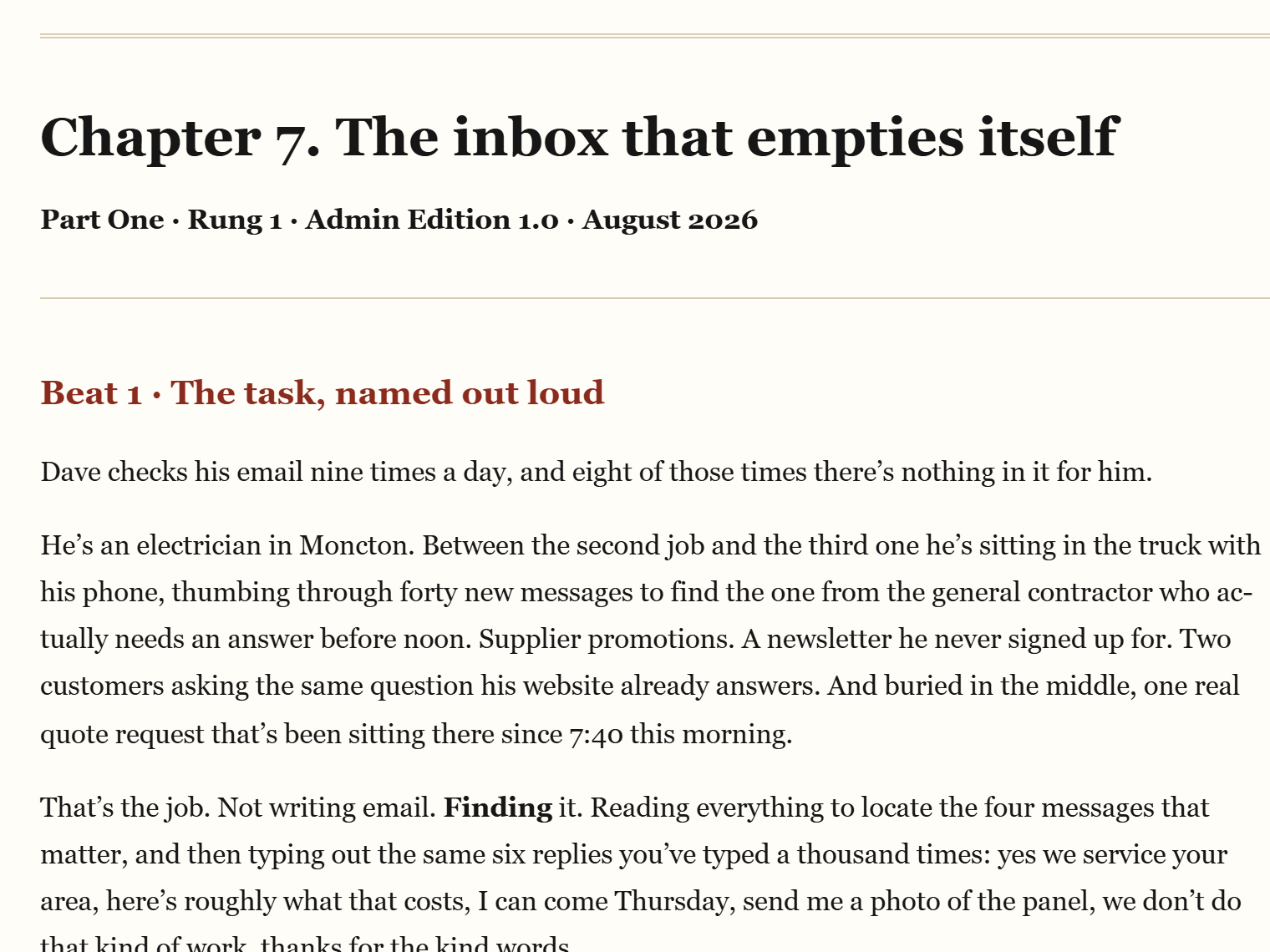
The opening page of chapter 7. Dave, an electrician in Moncton, checks his email nine times a day and eight of those times there is nothing in it for him.
Every chapter opens on a real owner and a real Tuesday. No jargon, no setup, no assumed knowledge.
A diagram from chapter 7. Forty new messages go through a first pass and come out as four piles: four replies drafted, two handoff notes, one booking with two times offered, and thirty-three ignored with a one-line reason each.
Every idea gets a picture. This one is forty messages becoming four decisions, and nothing sends itself.
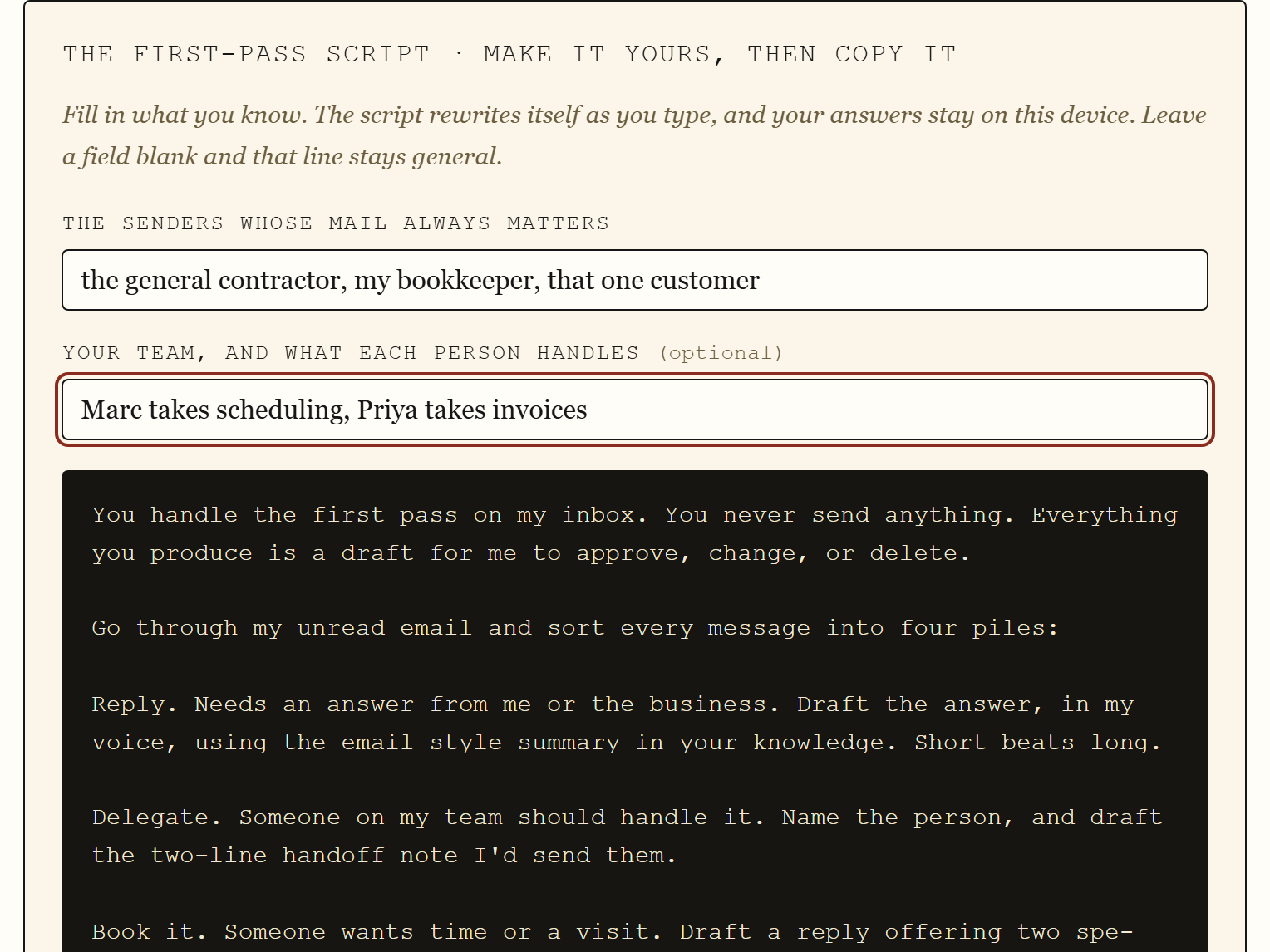
A script from chapter 7 with two fields filled in. The reader has typed their key senders and their team, and the script below has rewritten itself to include those details, with a copy button underneath.
The scripts rewrite themselves as you type your own details in, then copy with one button. Your answers stay on your device.
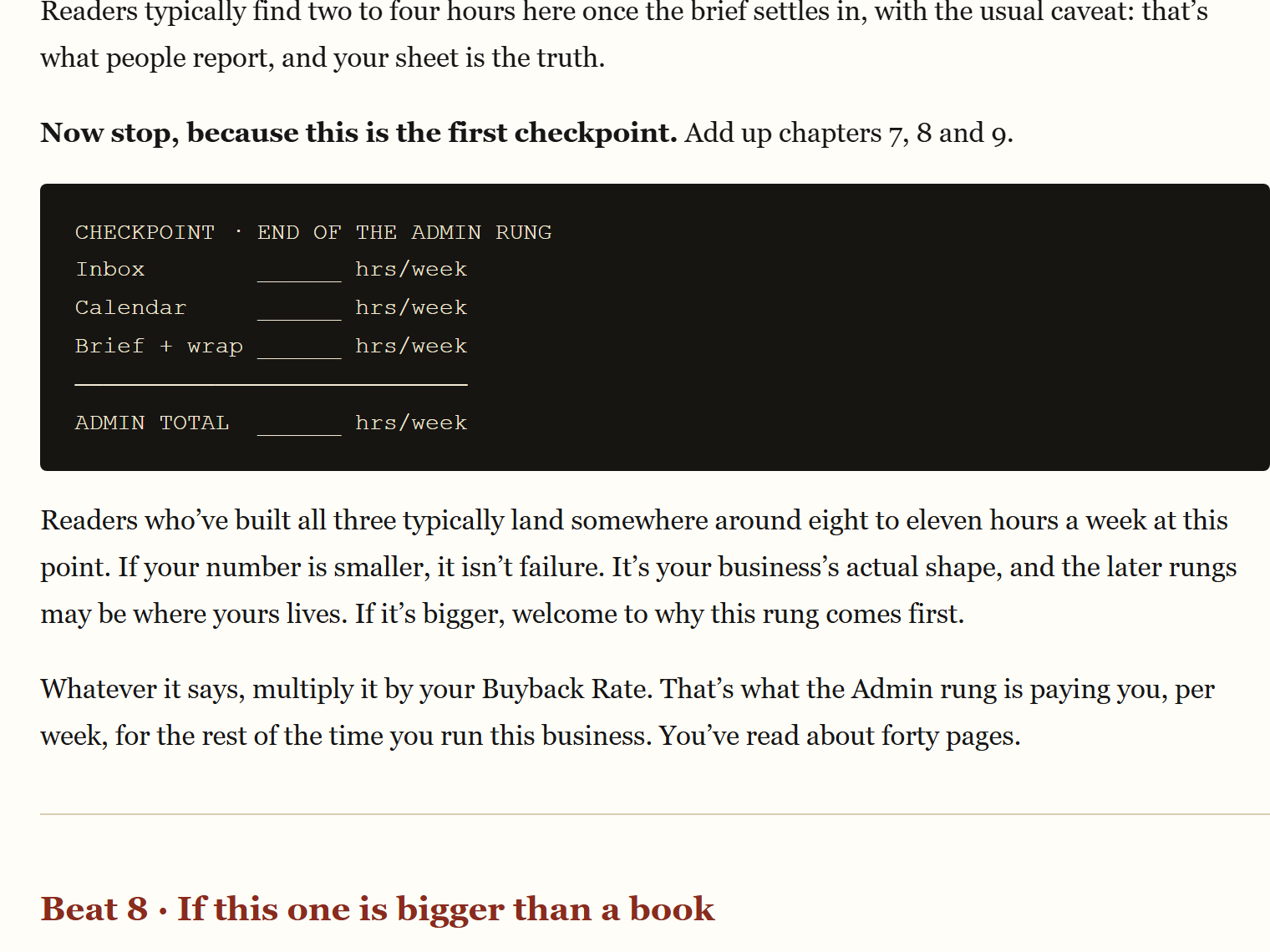
The checkpoint at the end of chapter 9. A tally box adds inbox, calendar, and brief plus wrap hours into an admin total, surrounded by text saying that what readers report is not the same as your own measured sheet.
And every chapter ends by counting. The number is one you measured, which is the only kind worth having.

Screenshots are from the actual file. The ranges the book quotes are what readers report, hedged every time they appear, and your own sheet is the number that counts.

Stay on the list

Want to know when it gets better?

The book is a living edition. When a chapter gets sharper, or the step by step instructions change because a tool moved, that goes out as a new edition. Leave your address and you get a short note saying what changed, where the new one is, and which chapter is worth a second look.

Editions and the occasional note about the book. Nothing else, no passing your address to anyone, and every email has an unsubscribe link that works the first time you click it.

Why this exists

The promise, in plain terms

  • One address, this one, that always has the newest edition
  • Every future edition free, for as long as the book exists
  • A changelog in plain language, so you can see what moved
  • Chapter numbers never change inside an edition, so you can cite them to someone

You got an hour back

Show someone what worked.

If a chapter gave you back real time, the number is worth showing. A screenshot of your tally, a photo of the page you wrote on, or a couple of sentences about what changed. Pick whichever is easiest. Someone one chapter behind you needs to see that it works for a business like theirs.

Door one · private

Send it to me

Straight to my inbox. I read every one of these, and it is the fastest way to shape what gets written next.

Email your win →
Door two · out loud

Post it in the community

Same thing, where other owners can see it. This is where someone one chapter behind you finds out it is worth finishing.

Post it in the community →

Before you send anything: cover or blur your customers' names, addresses and phone numbers. Your tally and your own words are the interesting part, and their details are nobody else's business.

Nothing you send gets shown anywhere without asking you first, by name, in a reply. If you would rather it stayed between us, say so and it will.

What has changed

Every edition, newest first.

Edition 1.1 August 2026

The reader-feedback revision. The central number is now the Reclaim Rate, the five rungs are named for the jobs they take off you, the front matter offers a fast way straight to chapter 6, every build chapter states its typical hours back right under the title, and two closing chapters covering the same idea became one, so the book is twenty-six chapters. Anything you already built keeps working; the scripts are unchanged where you pasted them.

Edition 1.0 First edition

The first complete edition: the five-rung ladder, every script, and the tally that adds your hours back up.

Chapters keep their numbers inside an edition. If something genuinely new has to go in between two chapters, it gets a letter, like 12A, so a number you wrote down still points at what you meant.